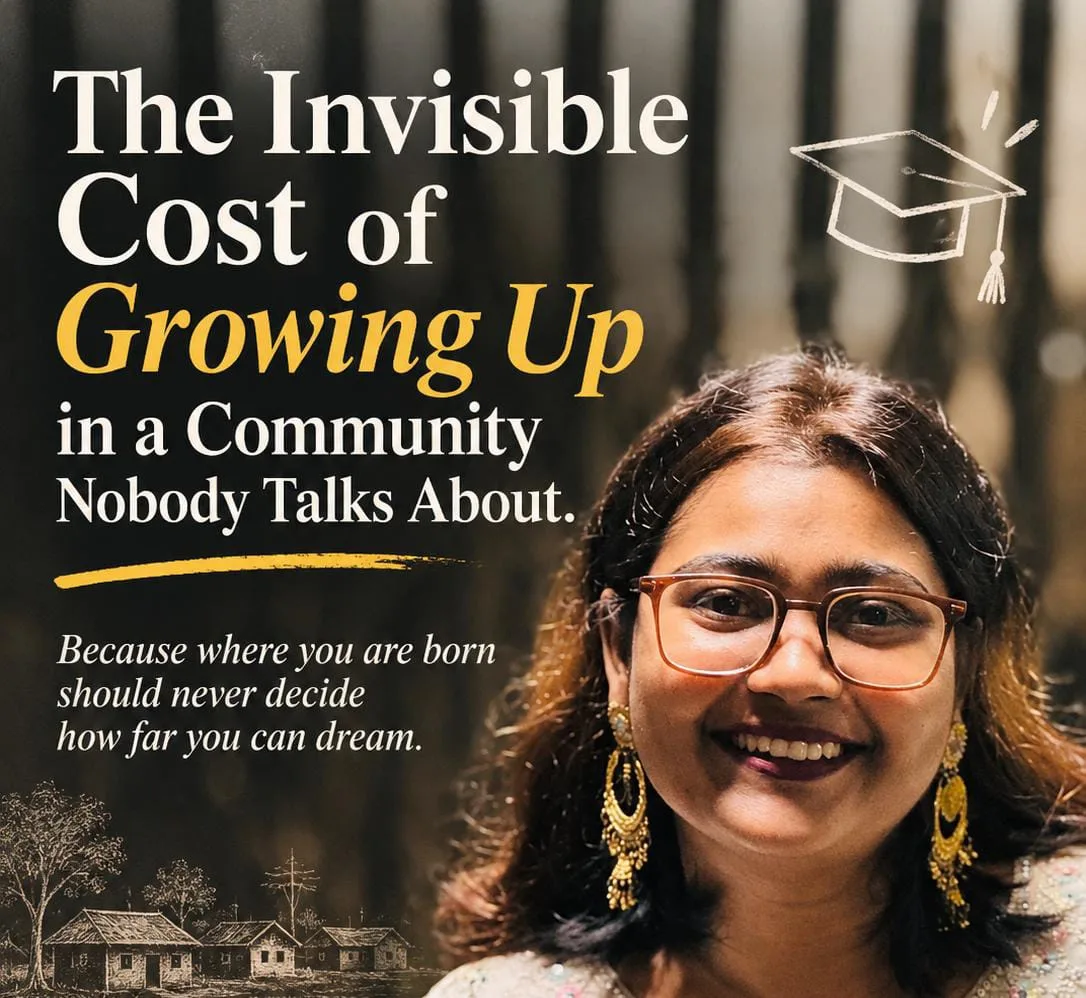
The Invisible Cost of Growing Up in a Community Nobody Talks About
There are places that rarely appear in national conversations unless something goes wrong. They become visible during natural disasters, political campaigns, poverty assessments or humanitarian emergencies. Between those moments, the people who live there largely disappear from public attention.
Growing up in such a community comes with a cost that is difficult to capture in statistics. It is not always measured by household income, school enrollment or employment rates. It is the cost of limited exposure, restricted choices, inaccessible opportunities and, perhaps most importantly, the gradual acceptance of limitations that were never supposed to define a person's potential.
Where someone is born should not determine how much of the world they are allowed to imagine.
Yet, for millions of children growing up in geographically and economically marginalized communities, geography quietly shapes ambition long before they are old enough to understand inequality.
When opportunity becomes a matter of geography
We often celebrate exceptional individuals who overcome difficult circumstances. Their stories are presented as evidence that determination can defeat almost any obstacle.
But there is something uncomfortable about how frequently we depend on exceptional stories to explain structural inequality.
A child growing up in a well-resourced city may have access to libraries, extracurricular activities, career counselling, reliable internet, scientific laboratories and adults who can introduce them to opportunities they did not know existed.
Another child, equally curious and capable, may have to navigate an entirely different reality. Their school might lack adequate learning resources. Their internet connection may be unreliable. Their family may not know how university admissions work, let alone how to access international scholarships.
Both children may have ambition. Both may have intellectual ability. But they are not competing from the same starting point.
We continue to describe success as the outcome of individual merit while paying insufficient attention to the conditions that make merit visible in the first place.
The opportunities people never learn exist
One of the most overlooked dimensions of inequality is the absence of exposure.
It is difficult to pursue an opportunity when you have never heard of it. It is difficult to imagine becoming a researcher when you have never met one. It is difficult to apply for an international scholarship when nobody around you knows that such opportunities exist.
This is an inequality that does not always announce itself.
It operates quietly through limited networks, inaccessible information and the absence of role models. Over time, children begin to measure their ambitions against the opportunities immediately surrounding them.
Some stop asking questions, not because they lack curiosity, but because their environment has repeatedly taught them that certain possibilities belong somewhere else.
The tragedy is not that these children lack ambition. It is that society frequently fails to provide them with the conditions to develop it.
The burden of having to prove yourself twice
For young people from overlooked communities, achievement can come with an additional responsibility: constantly explaining where they come from and why their accomplishments matter.
They may have to demonstrate academic ability while simultaneously overcoming assumptions about their schools, language, location or socioeconomic circumstances.
Their achievements are sometimes treated as surprising exceptions rather than evidence of the talent that exists within their communities.
This creates an unfair expectation. Instead of institutions questioning why opportunities remain inaccessible, individuals are expected to produce extraordinary results despite those barriers.
Resilience is valuable, but it should never become an excuse for institutional neglect.
A society cannot keep celebrating how well people survive unequal conditions while refusing to examine why those conditions persist.
The problem with development narratives
Development conversations often focus on the visible indicators of progress: new infrastructure, increased enrollment, training programmes and the number of beneficiaries reached.
These indicators matter. But they do not always reveal whether people have gained meaningful control over their futures.
A training programme may reach hundreds of young people without creating pathways to employment. A school may report strong enrollment figures while students continue to lack access to quality education. A digital initiative may introduce technology without ensuring that communities can afford reliable connectivity.
We need to ask more difficult questions.
Are young people gaining opportunities they can actually use? Are rural communities participating in decisions that affect them? Are institutions investing in long-term access rather than temporary interventions?
Development should not be measured only by what has been delivered. It should also be measured by what people are now able to do that they could not do before.
Beyond celebrating individual success
My engagement with education and youth advocacy has repeatedly reinforced one belief: talent is distributed far more widely than opportunity.
I have seen how a single conversation, an accessible learning resource or an introduction to an unfamiliar possibility can change the way a young person thinks about their future.
But individual initiatives cannot replace systemic responsibility.
Governments must invest in equitable educational infrastructure. Schools need access to trained educators, laboratories, libraries and digital resources. Young people outside major urban centres must be included in policy discussions, scholarship programmes and leadership opportunities.
Most importantly, communities should not have to wait for someone exceptional to emerge before their needs become visible.
They deserve investment because their people deserve opportunities, not because their stories might eventually become inspirational.
A different way of measuring potential
Perhaps we need to reconsider the language we use when discussing disadvantaged communities.
Instead of asking why so few young people from certain places reach international institutions, we should ask what prevented more of them from getting there.
Instead of celebrating the rare individual who navigated every barrier, we should examine the barriers themselves.
And instead of treating geography as a background detail in someone's biography, we should recognize how deeply it can influence access to education, information, networks and influence.
A child's potential should never be interpreted through the limitations of their surroundings.
The real measure of an equitable society is not how many extraordinary individuals manage to escape unequal circumstances. It is whether ordinary children, regardless of where they are born, can access the resources and opportunities necessary to build meaningful lives.
There are communities that do not need another inspirational story written about their struggles. They need institutions willing to recognize their realities, invest in their futures and include them in decisions.
Because being born somewhere that the world rarely talks about should never mean growing up believing that the world has nothing to offer you.

Written by
Shreya Ghosh
Shreya Ghosh reports for News Trial, covering the stories that matter with fast, fair and factual journalism. The world, in seconds.