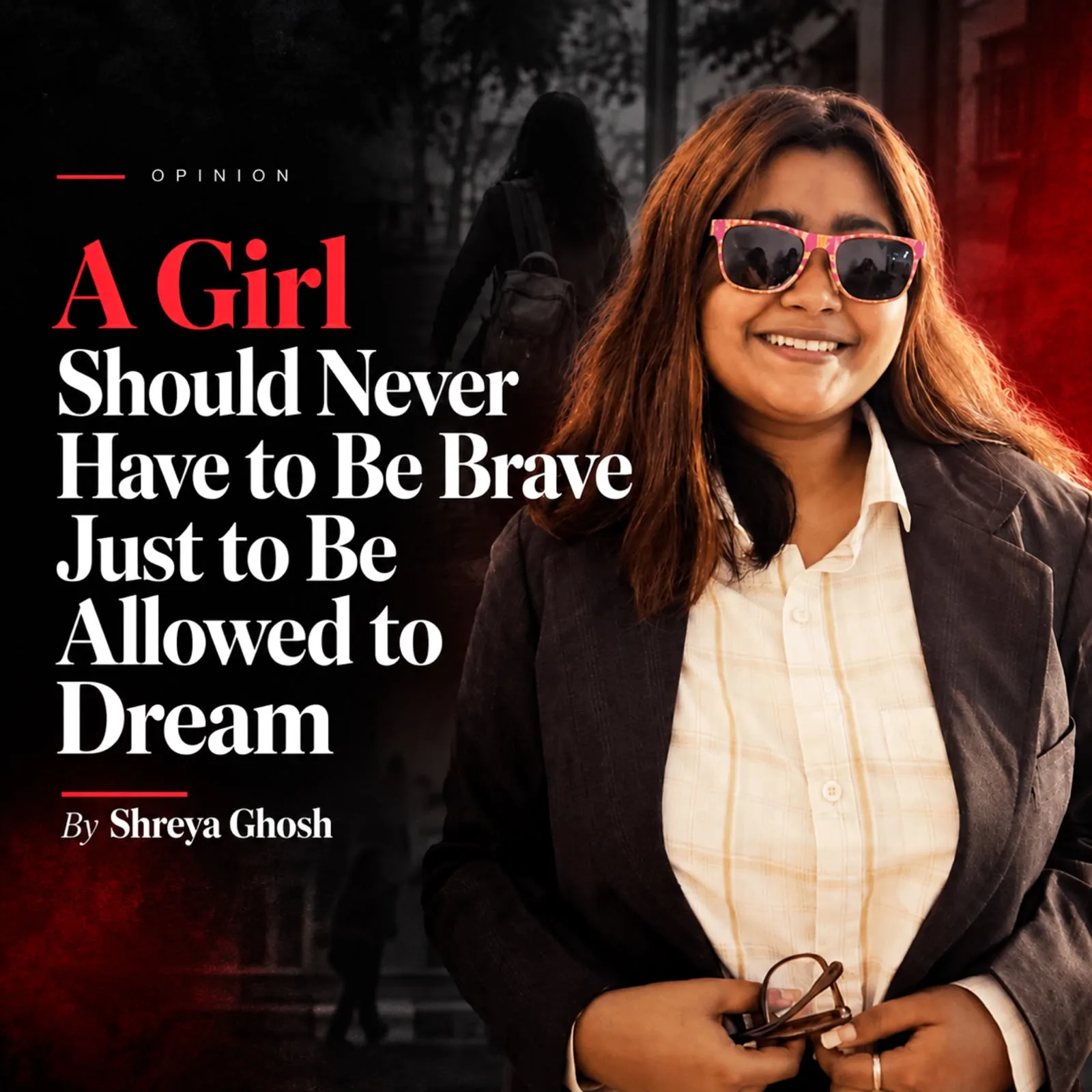
A Girl Should Never Have to Be Brave Just to Be Allowed to Dream
By Shreya Ghosh
In a Nutshell
- 1
Shreya Ghosh is a Global youth leader, working on gender equality, health awareness, children's rights, and youth participation.
Every year on October 11, the world observes the International Day of the Girl Child. We talk about girls’ rights, education, equality, safety, and empowerment. We share photographs, publish statements, organize discussions, and remind one another that every girl deserves a future filled with possibilities.
But I often wonder what these words mean to a girl who has never been told that her dreams matter.
What does empowerment mean to a girl who is expected to leave school before she is ready? What does equality mean to a girl who cannot speak openly about her own body? What does safety mean to a girl who has learned to remain silent because speaking up might bring shame upon her family? And what does opportunity mean to a girl who has the potential to change the world but has never been given the chance to see what is possible beyond her immediate surroundings?
These are not abstract questions to me. Growing up in a small town in northern Bangladesh, I have come to understand that a girl’s opportunities can be shaped by where she is born, the resources available to her, the expectations placed upon her, and the society that teaches her what she should or should not become.
That is why the International Day of the Girl Child must mean more than a celebration. It must be a reminder of the work that remains unfinished.
The world does not lack talented girls. It lacks equal opportunities for them.
There are girls who want to become scientists but are discouraged from pursuing science. Girls who want to become journalists but are told to choose a safer profession. Girls who want to lead but are expected to be obedient first. Girls who are curious about the world but grow up in environments where asking questions is considered disrespectful.
Some girls have access to books, technology, mentors, and international opportunities. Others struggle to obtain the most basic educational resources. Some are encouraged to speak confidently, while others are taught that being a good girl means not making too much noise.
The difference is not necessarily their intelligence, ambition, or potential. Too often, it is access.
We cannot meaningfully discuss gender equality without acknowledging the inequalities that exist among girls themselves. A girl living in a rural community, a girl with a disability, a girl from a low-income family, and a girl growing up in a well-resourced city may experience the world very differently. Their challenges cannot be addressed through a single, universal solution.
If we genuinely want to empower girls, we must begin by listening to them. Not merely speaking on their behalf, but creating spaces where they can identify their own challenges, articulate their own ambitions, and participate in decisions that affect their lives.
A girl should not have to prove that she is exceptional before she deserves an opportunity. Education, dignity, safety, and freedom are not rewards for extraordinary achievement. They are rights.
When silence becomes a barrier to girls’ health
My work on health misinformation and menstrual stigma in rural Bangladesh has reinforced my belief that gender inequality often begins with the things we refuse to discuss.
Menstruation is a natural biological process, yet many girls grow up feeling embarrassed about their own bodies. Conversations about menstrual health, reproductive health, consent, and personal safety can remain difficult in conservative communities. Misinformation fills the spaces where accurate, accessible information should exist.
Through community-based advocacy and awareness activities across rural villages, I have worked to encourage conversations about menstrual health, good and bad touch, urinary tract infections, HPV, PCOS, and other issues that affect girls and women.
These conversations matter because information is not simply information. For a girl who has never been encouraged to ask questions about her body, accurate knowledge can be the beginning of self-advocacy. It can help her recognize when something is wrong, seek appropriate support, and understand that she has a right to bodily autonomy.
We cannot protect girls by keeping them uninformed. We cannot eliminate stigma by pretending that sensitive issues do not exist. And we cannot build a healthier generation while making girls feel ashamed of their own biology.
Comprehensive, age-appropriate, scientifically accurate education must be accessible to every child. Families, schools, healthcare professionals, community leaders, and policymakers all have a role to play in making that possible.
Most importantly, we must learn to speak with girls without judging them for asking questions.
Beyond protection: Let girls participate in decisions
When we talk about girls, our conversations often focus on their vulnerability. We discuss how to protect them from violence, exploitation, discrimination, and harmful social practices. This work is essential. Every child deserves to grow up in safety.
However, I believe we must also change the way we see girls.
Girls are not merely beneficiaries of development programmes. They are thinkers, researchers, organizers, storytellers, community leaders, and decision-makers. They have ideas about the problems affecting their communities and valuable insights into the solutions that might work.
My experience as a member of the State of Youth International Youth Board, an initiative connected to KidsRights and the International Children's Peace Prize, has allowed me to connect with young people and youth leaders across different communities. It has strengthened my understanding of the importance of youth participation and the possibilities that emerge when young people are given meaningful opportunities to contribute.
Representation matters, but representation alone is not enough. Inviting a girl into a room means very little if nobody listens when she speaks. Giving a young woman a leadership title means little if she has no influence over decisions. Asking girls to share their experiences is not meaningful participation if their recommendations are ignored.
We need to move beyond symbolic inclusion.
Girls must be involved in designing educational programmes, shaping health initiatives, developing community solutions, and evaluating the policies that affect their futures. Their participation should not depend on their ability to speak a particular language, afford technology, travel internationally, or already possess an impressive list of achievements.
A girl should be able to contribute because her perspective matters, not because she has overcome enough obstacles to become an inspiring story.
Education must open doors, not simply keep girls in classrooms
Education is frequently described as the answer to gender inequality. It is undoubtedly one of the most powerful tools available to us, but we must ask what kind of education girls are receiving and what opportunities exist beyond the classroom.
Enrolling girls in school is important. Keeping them in school, ensuring that they learn in safe environments, addressing financial barriers, and enabling them to pursue their interests are equally important.
Girls need teachers who encourage their curiosity rather than limit their ambitions. They need access to books, laboratories, digital resources, scholarships, and mentorship. They need education that helps them understand their rights, develop critical-thinking skills, and make informed decisions about their lives.
They also need systems that recognize the realities of poverty and unequal access. We cannot tell a girl to dream bigger while ignoring the cost of education, the absence of reliable internet, the distance to her school, or the unpaid responsibilities she carries at home.
As someone who has navigated educational aspirations and opportunities from Bangladesh, I understand how profoundly access can shape a person's journey. Talent may create possibilities, but without the resources to pursue them, those possibilities can remain frustratingly out of reach.
We must therefore invest not only in girls' aspirations but also in the practical support that allows those aspirations to become achievable.
Scholarships, accessible learning resources, safe schools, mentorship programmes, and equitable digital access should not be treated as luxuries. They are part of building a world in which a girl's birthplace and family income do not determine the limits of her future.
Gender equality must begin in everyday life
Gender equality is not only about changing laws or increasing the number of women in leadership positions. It also requires examining the everyday behaviours and assumptions through which inequality is reproduced.
It begins when a family encourages its daughter to study as seriously as its son. It begins when household responsibilities are shared rather than automatically assigned to girls. It begins when adults listen to children without dismissing their concerns because of their age or gender.
It begins when a community stops treating a girl's ambition as a threat to tradition and starts recognizing her right to make informed choices about her future.
And it begins when we teach boys that equality does not diminish them. Respect, consent, emotional responsibility, and shared opportunities benefit everyone. Girls should not have to carry the entire responsibility for dismantling gender inequality. Families, institutions, boys, men, and community leaders must become active participants in this work.
We must also recognize that empowerment does not mean asking every girl to become a leader, entrepreneur, scientist, or activist. A girl should have the freedom to choose a life that reflects her own interests and values. Equality is not about replacing one set of expectations with another. It is about allowing girls to make choices without discrimination, coercion, or fear.
The goal is not to tell every girl what she can become. It is to ensure that nobody else gets to decide what she cannot become simply because she is a girl.
What should the International Day of the Girl Child leave behind?
A day of awareness is valuable, but awareness without sustained action can become a ritual that makes us feel as though we have done enough.
This October 11, I hope we ask ourselves more difficult questions.
How many girls are still unable to access quality education because of financial hardship? How many are denied accurate information about their health? How many experience violence but do not feel safe reporting it? How many talented young women have been excluded from opportunities because they lack internet access, mentorship, funding, or the right connections?
And, perhaps most importantly, how many girls have stopped dreaming because the world repeatedly taught them that their dreams were unrealistic?
The answers should shape what we do after the commemorative posts disappear.
Governments must strengthen the implementation of laws and policies that protect children's rights. Educational institutions must create inclusive and safe learning environments. Healthcare systems must provide accurate, accessible, and respectful care. Organizations must ensure that their programmes reach girls who are often overlooked. Communities must challenge harmful stereotypes rather than pass them on to another generation.
We must also invest in girls' own ideas, leadership, and community initiatives. Sometimes meaningful change begins with a well-resourced institution. Sometimes it begins with a conversation in a classroom, a community meeting, or a small village where someone finally creates space for girls to speak.
Both matter.
As individuals, we can begin by listening, questioning our assumptions, sharing reliable information, supporting girls' education, and refusing to normalize discrimination when we encounter it. These actions may appear small, but collective change depends on what we choose to accept and what we choose to challenge.
A future in which no girl has to ask permission to believe in herself
I think about the girls growing up in communities like the one where I grew up. Girls who are curious about the world, who have questions they are afraid to ask, and who may not yet realize how many possibilities exist beyond the boundaries of their immediate circumstances.
I want them to know that their questions are not a weakness. Their ambitions are not selfish. Their voices are not an inconvenience. Their bodies are not a source of shame. And their worth does not depend on how much they achieve, how quietly they behave, or how comfortably they fit into society's expectations.
I want a girl to be able to pursue science without being told that it is not for her, to speak about her health without embarrassment, to participate in leadership without being treated as an exception, and to imagine a future without first calculating whether the world will permit her to have one.
But hope must be accompanied by responsibility. We cannot simply tell girls that they are powerful and leave them to fight unequal systems alone. We must build institutions, communities, and opportunities that make their rights real.
The International Day of the Girl Child is an opportunity to celebrate girls, but it is also a test of our collective commitment to them. Are we prepared to listen when their experiences challenge our assumptions? Will we invest in their potential even when the results are not immediate? Will we make room for girls who have no influential connections, no financial security, and no extraordinary platform from which to speak?
If our commitment to girls' rights is genuine, it must extend beyond a single day.
Because a girl's future should not depend on whether she is lucky enough to be born into the right family, the right community, or the right circumstances.
It should depend on her freedom to learn, her right to be safe, her access to opportunity, and her ability to decide what kind of life she wants to build.
This International Day of the Girl Child, let us stop asking girls to be endlessly resilient in the face of barriers we have the power to remove. Let us stop celebrating their ability to survive injustice without confronting the injustice itself.
Let us build a world in which girls are not required to be extraordinary to be heard, fearless to be safe, or exceptionally brave just to pursue an ordinary dream.
Every girl deserves more than the opportunity to overcome barriers. She deserves a world that no longer places those barriers in her way.
That is the future I want to work towards. And that is the commitment International Day of the Girl Child should ask of all of us.
Shreya Ghosh is a Global youth leader, working on gender equality, health awareness, children's rights, and youth participation.

Written by
News Trial Desk
Newsroom
News Trial Desk reports for News Trial, covering the stories that matter with fast, fair and factual journalism. The world, in seconds.